
The housebuilding industry is entering a new phase of energy transition.
For several years, discussions around the Future Homes Standard have focused on technologies, carbon reductions and compliance pathways. Today, the conversation is becoming far more practical.
How do developers physically deliver the level of renewable energy generation future homes are expected to require?
As the industry moves towards higher-performing, lower-carbon homes, solar PV is increasingly becoming a fundamental part of residential design rather than an optional upgrade. However, at the same time as renewable energy requirements are increasing, a new challenge is emerging that could significantly affect how much solar can be installed on many new homes.
Why roof space matters more than ever
Future Homes Standard requirements are expected to increase the importance of on-site renewable energy generation as part of the overall compliance strategy for new housing developments.
For many housebuilders, solar PV will become one of the most effective and scalable ways to support:
- Improved dwelling emissions performance
- Reduced operational energy demand
- Future compliance requirements
- Homeowner energy savings
- Net zero commitments
However, unlike many other building services, solar generation is entirely dependent on available roof area.
The amount of usable roof space directly influences how much renewable energy can be generated from a property.
As compliance targets increase, maximising roof utilisation becomes increasingly important.
The impact of proposed Part B separation distances
 Alongside Future Homes Standard developments, the industry is also reviewing proposed changes to Approved Document B relating to fire safety.
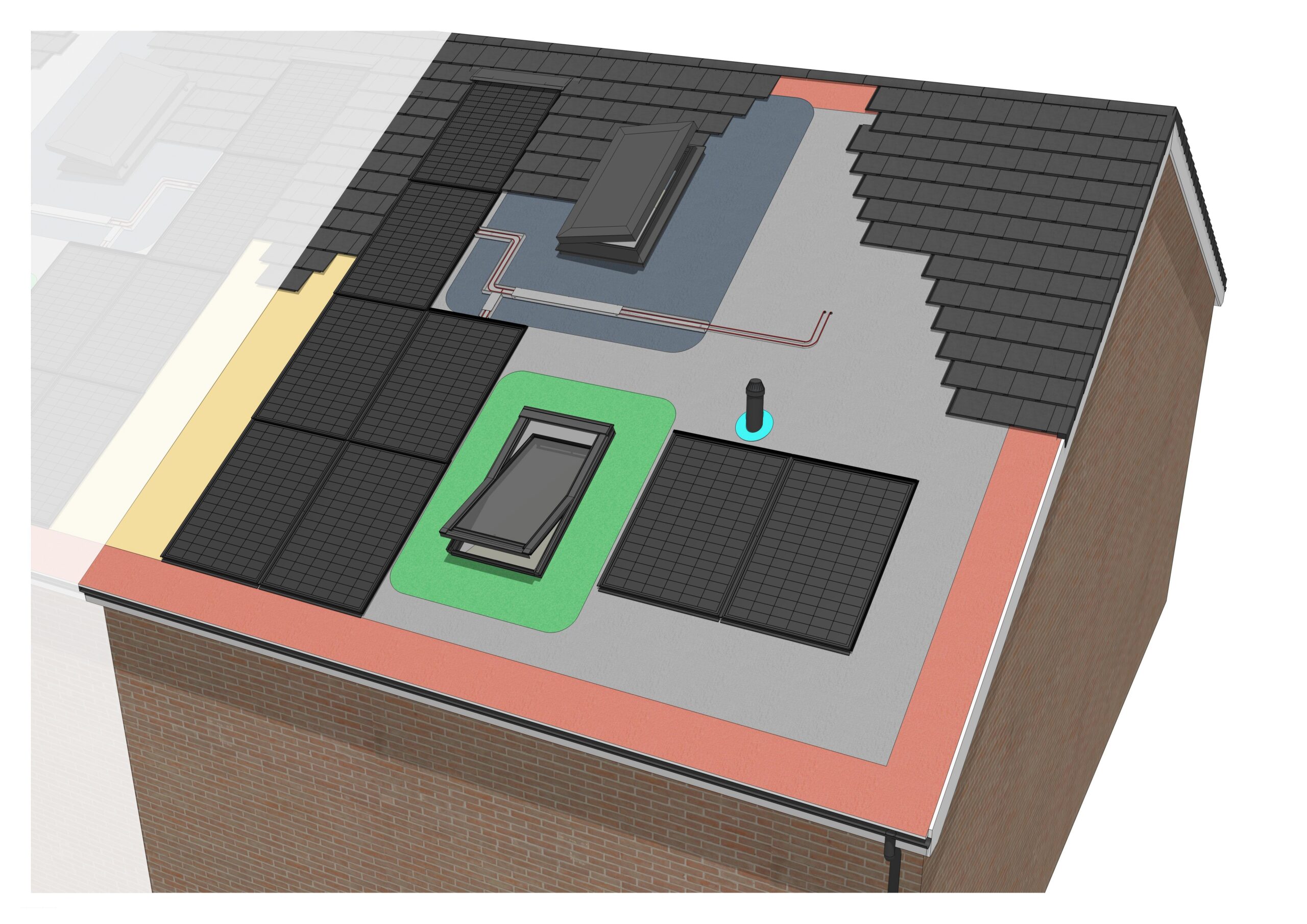
One area attracting increasing attention is the potential impact of separation distances around roof-mounted technologies.
While fire safety remains an essential consideration in residential design, the practical consequence of these separation requirements may be a reduction in the roof area available for renewable energy installations.
For some house types, particularly those with:
- Smaller roof planes
- Complex roof geometries
- Multiple hips and valleys
- Roof windows
- Ventilation terminals
- Architectural constraints
The cumulative effect of these exclusions could significantly reduce available installation space.
In some cases, this could create tension between the desire to maximise renewable energy generation and the practical limitations of the roof itself.
Designing around constraints
Historically, solar systems have often been considered relatively late in the design process.
As Future Homes requirements evolve, this approach may become increasingly difficult.
Technical teams are beginning to assess roof layouts differently, considering not only aesthetics and construction requirements, but also:
- Renewable energy yield
- Compliance performance
- Future flexibility
- Installation practicality
- Long-term homeowner outcomes
This shift means roof design is becoming a more strategic component of overall energy performance.
The question is no longer simply whether solar can be installed, but whether enough solar can be installed to support future compliance and homeowner expectations.
Why system flexibility is becoming increasingly important
As roof space becomes more constrained, the flexibility of the solar system itself becomes increasingly valuable.
Solutions that can adapt to varying roof layouts, accommodate complex geometries and maximise usable installation areas may offer significant advantages compared to more rigid installation approaches.
For housebuilders delivering large developments with multiple plot types, this flexibility can help reduce redesign requirements, improve consistency and support more efficient delivery across a wider range of homes.
The challenge facing the industry is unlikely to be solved through larger roofs or simplified house types.
Instead, it will require closer integration between building design, fire safety considerations and renewable energy strategies from the earliest stages of development.
Looking ahead
Future Homes Standard delivery is often discussed in terms of technologies, regulations and compliance metrics. However, one of the most important challenges may ultimately be physical space.
As renewable energy requirements increase and proposed fire safety considerations continue to evolve, developers will need to maximise every available square metre of roof area.
Those who successfully integrate roof design, fire safety requirements and renewable energy strategies at the earliest stages of development are likely to be best positioned for efficient Future Homes delivery.
Why this matters for housebuilders
For housebuilders, the challenge is not simply selecting a solar PV system. The challenge is delivering renewable energy generation consistently across multiple house types, roof configurations and development sites while maintaining buildability, compliance and commercial viability.
This is one of the reasons Solfit has focused heavily on design flexibility from the outset.
Our integrated solar roofing system has been developed specifically to help address the challenges associated with constrained roof layouts, enabling panel configurations to adapt more effectively around potential roof restrictions while maximising usable roof area for renewable energy generation.
More importantly, we believe Future Homes delivery requires more than products alone. It requires repeatable solutions that support standardisation, simplify specification and provide confidence that renewable energy strategies can be delivered consistently across a wide range of house types.
As the industry moves towards a more specification-led approach to Future Homes compliance, the ability to maximise roof utilisation while maintaining design flexibility is likely to become an increasingly important consideration.
Watch our latest industry insight animation
Our latest animation explores how proposed Part B separation distances could affect available roof space for solar PV installations and why roof utilisation is becoming an increasingly important consideration for Future Homes delivery.
Click here to discover our integrated renewable energy solution for new home developments.


