
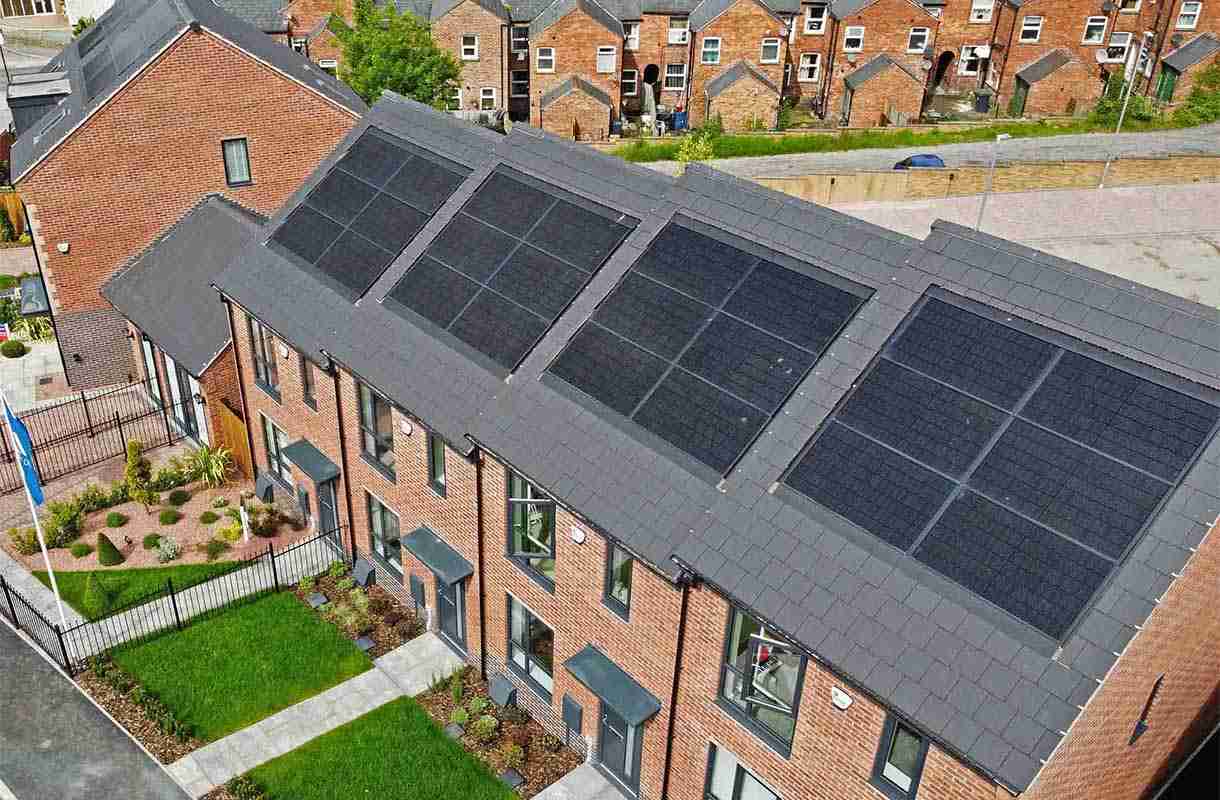
Roof-integrated solar is now widely adopted across new residential developments.
Driven by regulatory change and the Future Homes Standard, solar is no longer an optional upgrade. It is becoming a core part of compliance strategy.
However, as deployment increases, so do system failures. These failures are rarely caused by individual components. They are typically the result of how systems are designed, specified and delivered at scale.
For housebuilders, this introduces a different type of risk, one that sits across design, construction and long-term performance.
Why roof-integrated solar systems fail
In many developments, solar is still treated as a product rather than a coordinated system.
This creates variability at every stage, and that variability is where failure occurs.
The most common failure points are not isolated issues. They are symptoms of a fragmented approach to specification and delivery.
1. Incomplete specification at design stage
A consistent issue across residential projects is that solar is not fully defined during planning or technical design.
Instead, it is often:
- Passed through the supply chain with limited detail
- Finalised during procurement or installation
- Adapted plot-by-plot based on constraints
The impact:
- Late-stage redesign
- Inconsistent system layouts across house types
- Increased coordination during construction
- Reduced energy performance per plot
This is not a construction-stage issue. It is a specification-stage failure.
What appears as an installation issue is typically the result of decisions not being made early enough in the design process.
2. Distributed electrical architecture and system risk
Many traditional solar PV systems rely on distributed DC architecture, where electrical connections are spread across the roof and building.
This introduces:
- Multiple connection points
- Increased system complexity
- Greater exposure to failure and fault conditions
It also has implications under evolving fire safety requirements, particularly within Approved Document B.
As system size increases to meet energy targets, so does the level of distributed electrical risk. Without a controlled electrical design approach, this becomes difficult to manage consistently across developments.
3. Installation variability across plots
Even with a defined design, solar systems are often delivered by different contractors across different phases of a development.
This leads to:
- Variation in installation quality
- Inconsistent system configuration
- Increased defects and rework
- Difficulty maintaining standards at scale
The underlying issue is that the system relies too heavily on on-site interpretation, rather than controlled, repeatable application.
4. Misalignment between solar and roof design
Roof-integrated systems are frequently introduced after the roof design has been finalised.
This creates:
- Compromised system layouts
- Reduced usable roof area
- Inefficient panel placement
- Increased installation complexity
In a constrained design environment, this misalignment directly affects performance.
As requirements tighten under the Future Homes Standard, this becomes increasingly difficult to resolve.
5. Compliance gaps between design and delivery
Solar systems must now meet overlapping regulatory requirements, including:
- Energy performance targets
- Fire safety standards
- Material and system classifications
Where these requirements are not coordinated at design stage, the result is:
- Systems requiring redesign during delivery
- Reduced compliance confidence
- Increased cost to achieve required performance
As both energy and fire regulations continue to evolve, this risk is increasing.
6. Lack of system standardisation across developments
On many sites, solar systems vary between:
- House types
- Phases
- Contractors
This lack of standardisation introduces:
- Inconsistent outcomes
- Increased coordination between teams
- Difficulty managing quality at scale
For housebuilders delivering large developments, this creates unnecessary complexity.
The core issue: Solar is not being treated as a system
Across all of these failure points, the underlying issue is consistent:
Solar is being delivered as a product through the supply chain, rather than as a fully specified building system.
This creates:
- Variability
- Fragmentation
- Risk at every stage of delivery
What this means for housebuilders
As solar becomes a requirement rather than an option, the approach to specification must change.
Key considerations now include:
- Defining solar systems at early design stages
- Aligning system design with roof and building layout
- Reducing electrical and installation variability
- Ensuring consistency across developments
Without this, the impact is seen in:
- Lower performance
- Increased cost
- Greater compliance risk
- Ongoing maintenance and warranty exposure
Conclusion
Roof-integrated solar systems do not fail because of technology. They fail because of how they are specified and delivered.
As regulatory requirements increase and system scale grows, a more controlled, system-led approach becomes essential.
For housebuilders, the focus is no longer just on installing solar, but on how that solar is designed, integrated and delivered consistently across every plot.


