
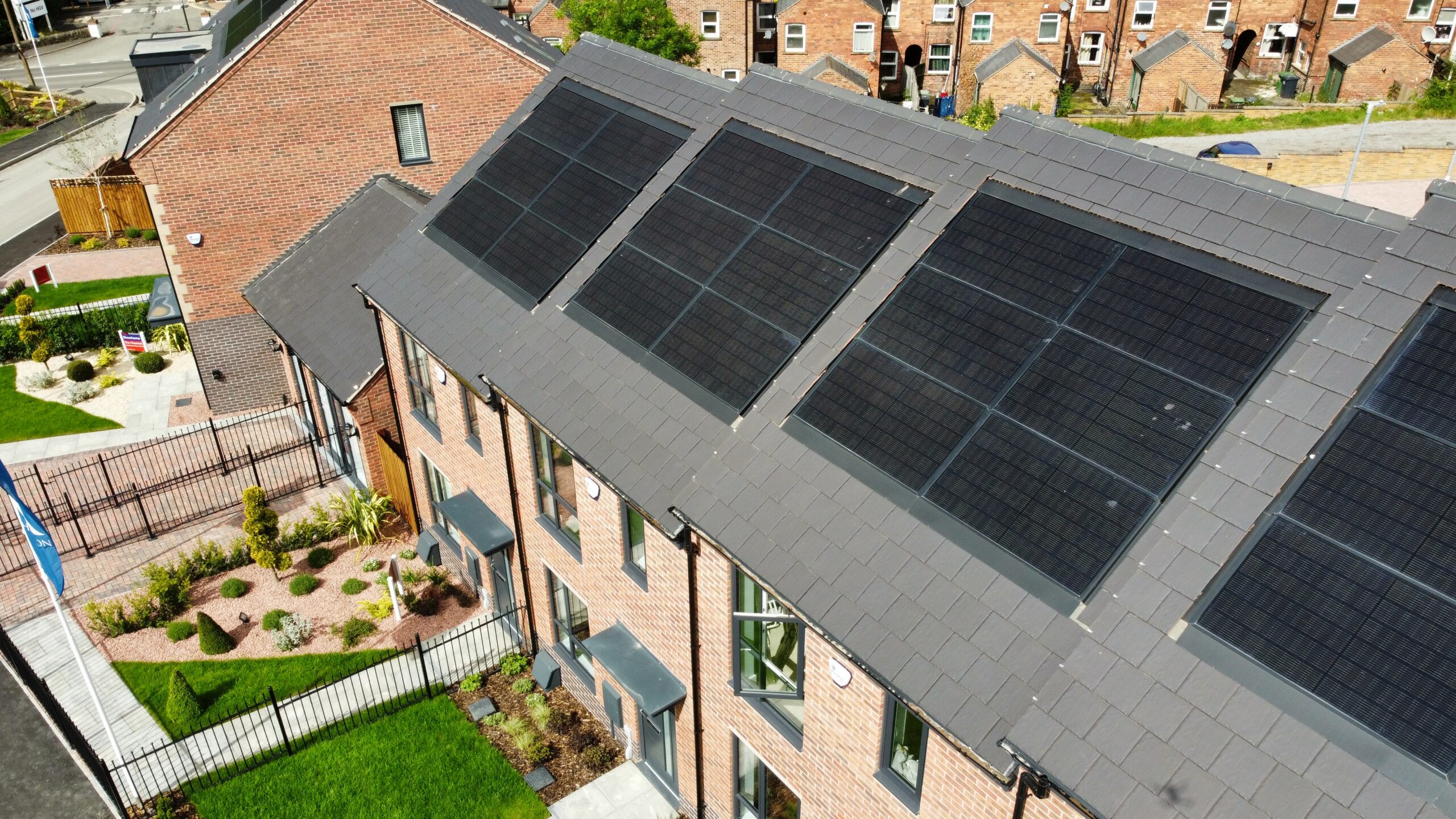
As solar becomes a standard feature on new homes, attention is rightly turning to how different PV systems behave in a fire. In November 2025, the Health and Safety Executive (HSE), working on behalf of the Building Safety Regulator (BSR), published an experimental update examining fire spread over pitched roofs fitted with solar panels. You can read the full report here.
The results are important reading for anyone specifying, designing or installing in-roof solar.
At Solfit, we welcome this research. Not because it raises concerns, but because it reinforces a principle we have always believed in – how an in-roof solar system is designed matters just as much as what it produces.
What did the HSE test?
The HSE carried out a series of large-scale fire experiments on pitched roofs fitted with both above-roof (BAPV) and in-roof (BIPV) solar systems. The tests were designed to simulate a realistic ignition scenario beneath the panels, such as a DC connector failure, and to observe how fire spreads vertically and horizontally across the roof.
Crucially, the work was commissioned to help inform future guidance in Approved Document B, meaning its findings are highly relevant for housebuilders and specifiers looking ahead.
Key findings for in-roof solar systems
The most striking results relate to plastic tray–based in-roof systems.
Across multiple tests, in-roof systems that relied on plastic trays beneath standard solar panels showed:
- Rapid vertical fire spread, often reaching the ridge within minutes
- Significant horizontal fire spread beneath the array
- Flames extending above the roof line
- Fires that were difficult to extinguish, as flames were contained within sealed cavities
Notably, improving the fire rating of breather membranes alone did not significantly reduce fire spread where large amounts of combustible material remained within the system.
In simple terms – the amount and type of material beneath the panels mattered more than paper fire ratings.
A clear contrast – integrated systems with less combustible material
One test stood out.
The HSE also assessed a bespoke integrated in-roof system that avoided plastic trays and reduced the amount of combustible material beneath the panels. This system showed:
- Slower and more limited flame spread
- Fire largely confined within the cavity
- No significant flame projection above the roof
- Reduced fire severity overall
The conclusion was clear, systems with less plastic and less fuel in the cavity performed materially better in a fire scenario.
What this means for Solfit
Solfit’s in-roof solar systems have always been designed around simplicity, robustness and real-world installation experience. That means:
- No plastic tray systems
- A straightforward, metal-based construction
- Reduced cavity complexity
- Fewer components and fewer potential failure points
The HSE research validates this approach. By focusing on reducing combustible mass and avoiding unnecessary plastics, fire risk is inherently limited at source rather than managed retrospectively.
Why this matters for housebuilders and installers
This research was commissioned by the Building Safety Regulator for a reason. As regulations evolve, scrutiny is likely to increase around:
- Fire spread over roofs and compartment lines
- Hidden cavities and trapped fires
- The real-world behaviour of in-roof solar systems, not just test certificates
For housebuilders, this means system choice is becoming a design and risk decision, not just a compliance box or a cost line.
Specifying or installing an in-roof solar system that is fundamentally low-fuel and installer-led helps future-proof developments against both regulatory change and reputational risk.
Designed by installers
At Solfit, our philosophy has always been simple – designed by installers, for installers. Fewer parts, fewer complications and systems that behave predictably on real UK roofs.
Independent HSE testing now reinforces that this philosophy also delivers tangible fire-safety benefits.
As solar becomes standard, design quality will matter more than ever. We believe the future of in-roof solar is not more layers, trays or plastics, but simpler, smarter, safer systems.
If you’d like to discuss Solfit’s approach, or how our in-roof solar systems support compliant, future-ready housing, we’d be happy to talk.


